


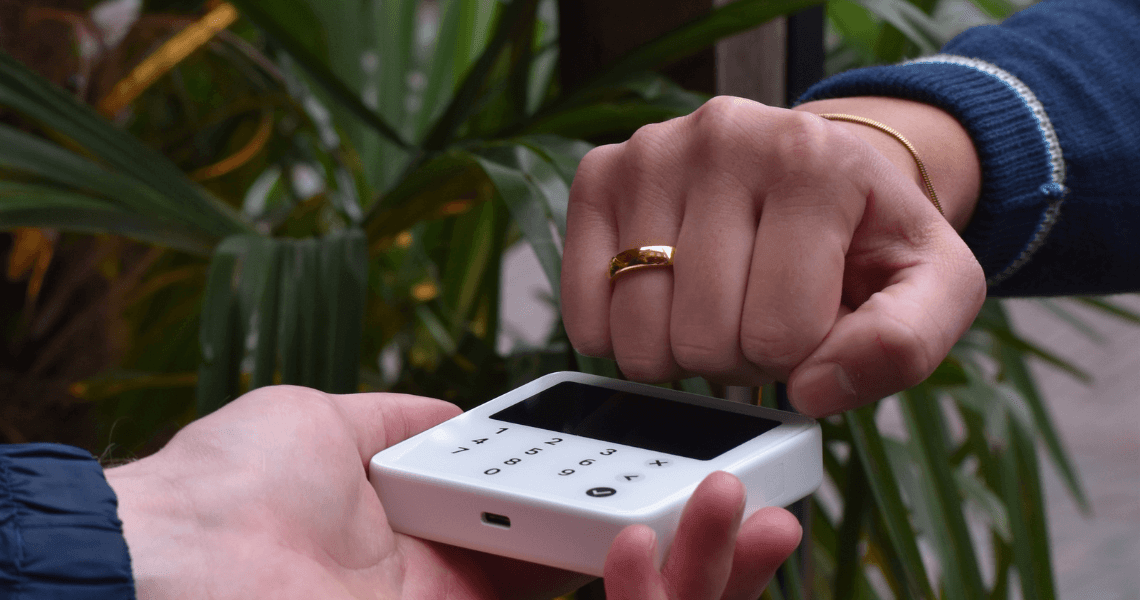
It is usually one of the first questions people ask.
If you can pay with a ring, is it actually safe?
The question makes sense. A payment ring sits on your hand and gives access to payments, so security needs to feel clear before convenience feels comfortable.
The reassuring part is that payment rings are not built on experimental systems or unfamiliar payment technology. They rely on the same security infrastructure already used by contactless bank cards and mobile payments across Europe and much of the world.
So while the form may feel new, the technology behind it is familiar.
Are payment rings safe?
Yes. Payment rings are designed around the same secure payment infrastructure used by modern contactless bank cards.
They use established banking networks, payment verification systems, tokenized payment technology, contactless rules, and fraud protection frameworks to help protect transactions. In practical terms, this means you are not switching to an entirely new payment ecosystem. You are using an existing and trusted one through a different form factor.
That familiarity is important. Payment rings feel innovative because they are wearable, but the security foundations behind them are already widely used and understood.
If you are new to the concept, it may also help to understand what a payment ring is and how it fits into everyday contactless payments.
How payment rings protect your payment data
Payment rings protect your payment information through a process called tokenization.
When you pay with a payment ring, your actual card details are not openly shared with the payment terminal. Instead, the system uses a secure digital substitute known as a token.
This token is linked to your wearable and payment setup but does not expose your original card number during normal contactless transactions. Even if payment data were intercepted, it would not provide direct access to your real card information.
This is not unique to payment rings. It is the same protection system used by major mobile wallets and modern contactless payment solutions.
If you want to understand the transaction process in more detail, it helps to read how a payment ring works during a payment.
Built on the same security system you already use
One of the most reassuring things about payment rings is that they are not introducing a completely new payment system.
A payment ring works within the same banking and payment infrastructure already used by contactless bank cards and mobile payments. That means the same payment networks, the same contactless rules, and the same security principles are involved behind the scenes.
The same encryption standards. The same tokenization systems that protect payment information. The same PIN verification for larger transactions. The same fraud protection logic that helps secure everyday payments. And the same banking rules people already trust when using ordinary contactless cards.
This matters because the security behind the payment is already familiar and widely trusted. The ring changes how you pay. Not the security behind it.
Before activating any wearable payment device, it is always worth checking compatibility through our supported banks page.
Can someone scan your payment ring without you knowing?
In normal real world use, this is extremely unlikely.
Payment rings use NFC technology, which only works at very short distances, usually within a few centimetres. The ring must be positioned close to a compatible payment terminal that is actively processing a transaction.
In other words, a payment ring does not continuously broadcast payment information or work from across a room. The short range is part of why NFC is widely used for secure contactless payments.
This also helps address common NFC skimming concerns. A payment ring is not designed to be read casually at long distance. A payment requires close positioning, a compatible terminal, and an active transaction environment.
If you want a deeper technical explanation, you can read our guide on NFC versus RFID technology.
Can a payment ring be hacked or cloned?
Payment rings are designed to make cloning and misuse difficult by using tokenized payment credentials rather than simply exposing your real card details.
This is an important distinction. A payment ring is not just a copy of your physical bank card. It uses secure payment provisioning and tokenization, so the wearable can make payments without revealing the original card number during normal use.
Like any payment technology, no system should be described as impossible to attack. But payment rings are built on mature banking security systems rather than untested wearable technology. That is why the risk should be understood in the same context as other modern contactless payment methods, not as something unfamiliar or experimental.
What happens if you lose your payment ring?
Losing a payment ring is generally handled in the same way as losing a contactless bank card.
If your ring is lost or misplaced, you can block or deactivate it through the relevant provider or payment system. Once blocked, it can no longer be used for payments.
Because payment rings operate within existing banking rules, contactless limits and PIN verification on higher amounts already help limit potential misuse. If someone physically has the ring, the situation is still treated like a lost payment item, not like full access to your bank account.
For most users, this makes the process familiar rather than complicated. The response is not unique to wearable payments. It follows the same logic already used for everyday banking products.
If you are preparing to activate a wearable for the first time, our setup guide explains the process.
Are payment rings safer than other payment methods?
Payment rings are generally considered as safe as contactless bank cards and mobile payments, while offering some practical advantages of their own.
Because transactions rely on tokenization, your actual card information is not openly exposed during normal payments. Compared with carrying a wallet containing multiple cards, some users also appreciate having fewer physical payment items with them.
That said, no payment method is completely risk free. Security always depends partly on how payment systems are used and managed. A ring should be treated with the same care as a bank card, especially if it is lost or stolen.
From a technology perspective, however, payment rings are designed with security as a core priority rather than as an afterthought. The key point is that they use the same trusted payment environment people already rely on every day.
If you are comparing payment methods more broadly, our guides on payment rings versus contactless cards and payment rings versus Apple Pay may also help.
Security without added complexity
One reason payment rings stand out is that they combine strong payment security with everyday simplicity.
There is no device to unlock, no settings to manage during payment, and no battery to worry about. The security is built into the payment infrastructure itself rather than something users need to actively control during every transaction.
This simplicity is also why many people choose payment rings when they want to pay without a wallet or phone in daily life.
A familiar system in a new form
It is easy to focus on the fact that a payment ring looks different.
But when it comes to security, what matters is what sits underneath.
The same payment networks. The same verification systems. The same tokenization principles. The same contactless payment rules people already know from everyday banking. The ring is simply another way to access that existing infrastructure.
That is the most important reassurance. Payment rings do not ask people to trust a new kind of security. They let people use the secure payment system they already trust, in a more wearable and convenient form.
From hesitation to confidence
Most people are cautious at first, and that is reasonable.
Security questions are part of understanding any payment method. People want to know how it works, whether it is reliable, and how their information is protected.
Once they understand that a payment ring operates within familiar banking systems and uses the same underlying protections as contactless cards, hesitation often becomes confidence.
What remains is the convenience. A payment method that is wearable, ready when needed, and designed with security built into the experience.
If you are curious about wearable payments, you can explore the full payment rings collection or browse our wider payment wearables guides.
Frequently asked questions about payment ring security
Security questions are usually practical. People want to know whether payment rings can be scanned, whether card details are stored, and what happens if the ring is lost.
Are payment rings safe to use?
Yes. Payment rings use the same security systems as contactless bank cards, including tokenization, PIN protection for larger purchases, and payment verification rules.
Can someone scan my payment ring remotely?
No. NFC works only at very short distances, meaning the ring must be held close to a compatible payment terminal.
Can a payment ring be hacked?
Payment rings use tokenized payment credentials and established banking security systems. No payment method is completely risk free, but payment rings are built on the same trusted infrastructure as other modern contactless payments.
Can a payment ring be cloned?
A payment ring is not just a simple copy of your bank card. It uses tokenization, which helps protect your real card details and makes misuse harder than copying ordinary static card information.
What happens if I lose my payment ring?
You can block or deactivate it through your provider or payment platform, similar to a lost bank card.
Do payment rings store my card details?
Payment systems use tokenization, which means your real card details are protected through secure digital substitutes rather than openly exposed during payments.
Are payment rings safer than carrying a wallet?
Many users feel they can be. Payment rings reduce the need to carry multiple physical cards while benefiting from tokenized payments and familiar banking protections.
Do payment rings require a phone to work?
No. Once activated, payment rings work independently. This is one reason many people use them to pay without their phone.
Where can I learn more about setup and compatibility?
You can visit our setup guide, supported banks page, or FAQ page for more information.


